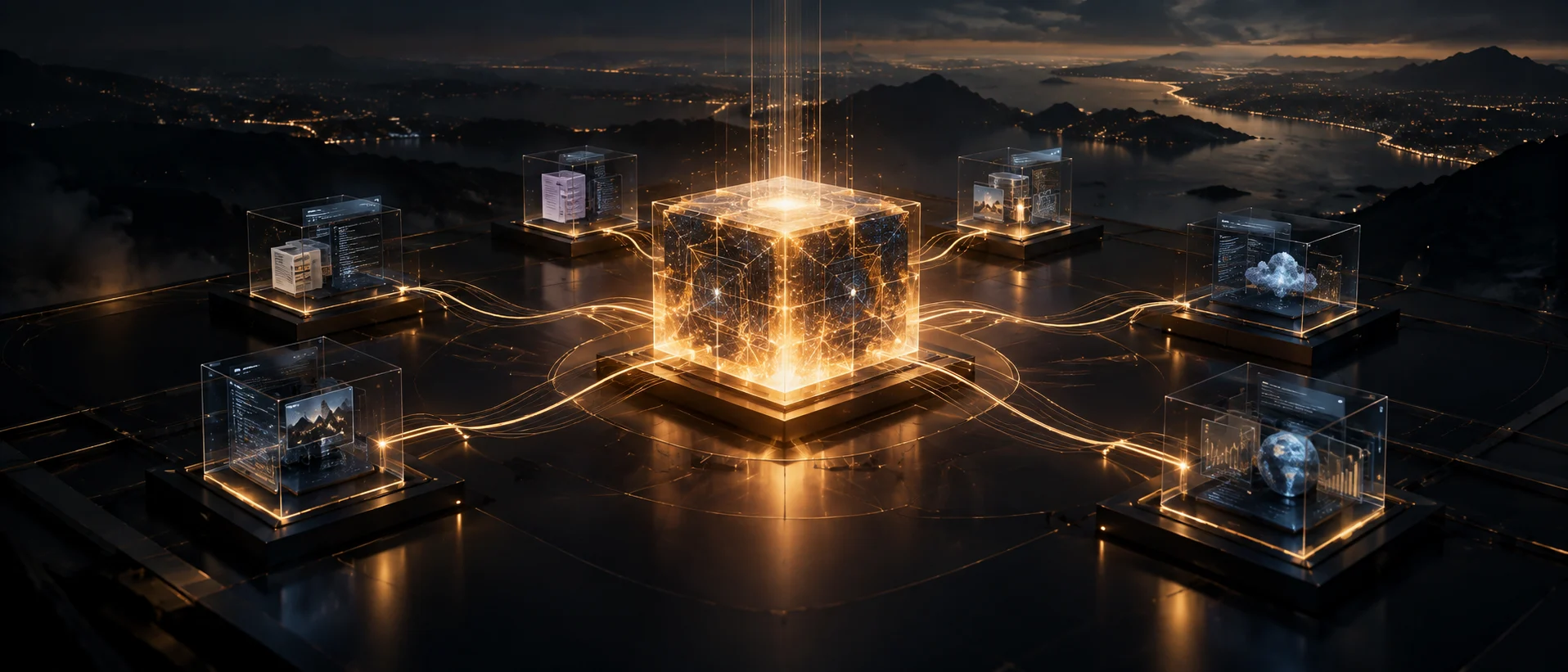
Only a few years ago, the typical interaction with artificial intelligence was easy to describe: a person asked a question, a model processed the available context and produced an answer. Modern AI agents shift that pattern. They are given not merely a prompt but a goal, and can gather information, open files, use software, run code and connect multiple steps into a larger piece of work.
The defining change of 2026 therefore lies not only in more capable language models. At least as important is the infrastructure built around them: working environments, tools, state management, memory mechanisms, resumability and, increasingly, the ability to divide work among multiple agents.[1][6][9]
AI is consequently beginning to evolve from a system that answers individual requests into a technical working environment capable of handling broader workflows. That is not the same as a fully autonomous digital worker, and the distinction matters. Even so, the threshold is significant because software can now, at meaningful scale, do more than generate information: within defined boundaries, it can act.
From chatbot to agent
A classic chatbot is essentially reactive: it receives an input, processes the current context and returns an answer. An agent works in a loop instead. It interprets a goal, plans possible steps, selects a tool, takes an action, evaluates the result and then decides what should happen next.
The difference is therefore not necessarily that an agent relies on a fundamentally more intelligent model. What matters is that the model is embedded in an environment in which it can trigger actions. Anthropic describes agents in similarly practical terms as AI systems equipped with tools that can, for example, run code, call external APIs or communicate with other agents.[2]
That definition removes some of the exaggeration surrounding the subject. An agent is not a digital human, nor does it automatically possess judgement, responsibility or a stable understanding of its environment. Technically, it begins as a language or reasoning model connected to tools, state and rules. That connection, however, changes what the system can do.
1. Agents can now operate computers
One of the most visible changes concerns access to graphical user interfaces. Traditional automation works best with APIs or precisely defined scripts: the system knows which field to address, which endpoint to call and which action should follow which. Modern computer-using agents can instead attempt to operate an interface more like a person, identifying visible elements, selecting buttons, opening menus and entering text.
OpenAI provides computer use within its agent infrastructure. An agent can inspect the visible state of a browser or computer environment and use that information to determine the next action.[3]
Microsoft made computer use generally available in Copilot Studio in May 2026; there, agents can operate web and desktop applications through a virtual mouse and keyboard even when no suitable API exists. Microsoft lists use cases including data entry, invoice processing and data extraction.[4][5]
The practical effect is substantial because older enterprise software can become at least potentially automatable even when it was never designed around modern interfaces. Where a person still reads information from a screen, fills out forms or transfers data between systems, an appropriately equipped agent can attempt to follow the same path.
That does not make conventional automation obsolete. APIs and deterministic workflows remain superior where reliability, speed and exact control matter. Interfaces change, unexpected dialogs appear, login flows fail, and a seemingly simple website may behave differently in another state. The advance is therefore less that computer use replaces existing automation than that it extends the boundary of what can be automated at all.
2. Agents can work for hours or days
Earlier agent systems often ran into a practical limitation: they could complete several steps, but longer tasks risked lost context, technical limits or failure after an interruption. Real work processes are rarely that clean. They contain waiting periods, human approvals, external dependencies and intermediate results that must persist over time.
In 2026, this problem is increasingly being addressed at the runtime layer. OpenAI describes its Agents API as infrastructure for agents that can continue working reliably for days. The platform handles parts of context management and orchestration while agents can work with files, run code and preserve intermediate results.[1]
Google introduced Agent Executor in May 2026 as a runtime architecture for long-lived agents. The design is notable because it does not assume uninterrupted execution. Agent workflows may last for hours or days while being paused by technical failures or human approval steps; event logs and snapshots are intended to make it possible to resume a process later without starting again from the beginning.[6]
Google's agent platform also supports asynchronous long-running jobs that can continue for up to seven days.[7]
This creates a fundamental distinction between a chat and a work process. A conversation normally depends on the current exchange; an agent process can begin a task, wait for external information, be interrupted and later continue from its previous state. What looks like an unglamorous infrastructure detail is in fact a prerequisite for representing real business processes reliably.
3. Agents can work with files, software and enterprise systems
A language model on its own is limited to the contents of its context window. Tools give it access to the digital environment in which work actually happens, including file systems, databases, enterprise software, browsers, code interpreters, cloud services, APIs and communication systems.
- file systems
- databases
- enterprise software
- browsers
- code interpreters
- cloud services
- APIs
- communication systems
From answering to doing
OpenAI's Agents API provides runtime environments in which agents can run code, work with files, connect external tools and produce artifacts. OpenAI also recommends isolating such environments and deliberately restricting access as part of the security model.[1][13]
At the product level, ChatGPT Work follows the same basic principle: information from applications and files can be combined to create documents, spreadsheets, presentations or web applications, with OpenAI describing workflows that can continue for hours.[8]
Anthropic is moving in a similar direction. Claude Opus 4.6 was explicitly extended in 2026 for longer-running agentic tasks and, in suitable environments, can perform analysis and work with documents, spreadsheets and presentations.[9]
The role of the model therefore changes in a fundamental way. It no longer merely answers questions about work; it can operate inside the working environment itself. The distinction is subtle but important: the task shifts from explaining how something should be done toward carrying out the work with the available tools and delivering a result.
4. Multiple agents can divide work among themselves
As tasks become longer and more complex, the need to divide work grows as well. A single agent no longer has to perform every step itself; a lead agent can analyse the goal and delegate subtasks to specialised agents. One might research sources, another analyse data and a third review code, while the lead agent integrates the results.
OpenAI integrates subagents directly into its Agents API and treats their coordination as part of the agent harness.[1]
Anthropic introduced agent teams in Claude Code in 2026, allowing several agents to work on different tasks in parallel and coordinate their results.[9]
Google's ADK Go 2.0 likewise provides a graph-based approach to multi-agent applications, including dynamic orchestration and human-in-the-loop processes.[10]
In a limited sense, this begins to resemble conventional organisations: not every unit does everything, and a larger objective is broken into specialised tasks. More agents do not automatically produce better results, however. Each additional unit creates communication overhead, cost and new failure modes. The technical advance lies in making complex work modular and, where useful, parallel.
5. The real breakthrough is the harness
Public discussion about AI still focuses mainly on the models themselves: GPT, Claude, Gemini, and the question of which system is currently most capable. For agents, however, another layer is becoming just as important — the harness, meaning the technical environment that guides the model, constrains it and connects it to tools.
- which tools are available
- when a tool may be used
- how context is stored
- how long an agent can operate
- how failures are handled
- when a human must be consulted
- how multiple agents are coordinated
The runtime becomes part of the intelligence
A harness determines which tools are available, when they may be used, how context and intermediate results are stored, how long a process may run, how failures are handled and where human approval is required. In multi-agent systems, it also determines how work is distributed and how results are assembled again.
OpenAI explicitly treats context management, tool use, subagents and robust runtime infrastructure as parts of this agent layer.[1]
Anthropic reaches a similar conclusion from practical work with long-running agents and explains why context compression alone is not sufficient when a system must operate reliably over extended periods.[11]
This shifts the question of where an agent system's capability actually comes from. An excellent model without an appropriate working environment remains primarily a powerful conversational and analytical tool. Only when combined with tools, memory, runtime, permissions and control mechanisms can it become an operational system. For many real applications, the quality of that overall construction may matter as much as the underlying model.
6. What already works well
Agents are not equally reliable across all kinds of work. They perform best today on tasks where the result can be checked relatively clearly and the system can quickly receive feedback about whether a step succeeded.
Software development is an obvious example. Code can be executed, tests can run automatically, errors can be detected and versions can be compared. This creates a feedback loop in which an agent not only produces work but can evaluate parts of it against objective criteria. That is one reason coding agents are among the most mature agentic applications.
Similar advantages exist in research, structured data processing, document creation and clearly defined enterprise workflows. Computer use extends the possible range further to tasks that were previously inaccessible through APIs.[2][4][8][9]
The common denominator is less dramatic than many product demonstrations suggest: the clearer the goal, the more structured the environment and the easier the result is to verify, the more reliably an agent can perform.
7. What still does not work reliably
The phrase “autonomous agent” can suggest a digital employee that receives an arbitrary goal and independently returns a correct result. Today's systems remain well short of that. Their autonomy is real, but technically bounded and strongly dependent on the task, the environment and the surrounding security architecture.
Errors accumulate
In multi-step tasks, an early error can influence every decision that follows. An agent that adopts a false assumption, misreads a file or chooses an unsuitable intermediate step may continue building on it. As a process becomes longer, the number of possible actions grows — and so does the number of possible failure paths.
User interfaces remain unpredictable
Computer use is more flexible than conventional RPA, but that flexibility comes at a cost. Websites change layout, pop-ups obscure controls, login flows demand additional checks, and unexpected states can pull an agent away from the intended process. Stable, controlled environments can reduce this risk, but they do not eliminate it.
Permissions become more critical
An agent that only generates text can produce incorrect information. An agent with access to databases, email, payment systems or production software can produce real-world changes. A quality problem can therefore become a security and governance problem.
Google explicitly notes that autonomous agents may issue refunds, modify databases or execute code, which makes robust security boundaries necessary.[12]
OpenAI likewise recommends isolated execution environments, restricted network access and separated credentials for agent workloads. The greater an agent's ability to act, the more important permission models, logging and approval points become.[13]
Humans remain part of the system
Actual usage duration also tempers the image of fully independent digital employees. Anthropic reports from real-world usage data that agents are working autonomously for longer, yet most work intervals remain relatively short. Among the longest Claude Code sessions, autonomous working time rose from under 25 minutes to over 45 minutes at the beginning of 2026 — substantial progress, but still far from a universally deployable, fully independent worker.[2]
The important development is therefore less the disappearance of the human than a new division of labour. Agents increasingly take on execution and coordination, while people set goals, grant permissions, review results and intervene when decisions are ambiguous or risky.
8. What actually changed in 2026
The agent revolution should be neither underestimated nor mystified. No new digital species appeared in 2026; what emerged instead was a considerably more robust infrastructure for machine-performed work.
In suitable environments, models can now work toward goals rather than merely answer isolated questions, select tools, operate applications and websites, modify files, break tasks into multiple steps and continue processes over longer periods. They can resume after interruptions, involve specialised subagents and request human approval at defined points.
- work toward goals rather than answer isolated questions
- select tools
- operate applications and websites
- modify files and software
- break tasks into multiple steps
- work for longer periods
- resume after interruptions
- use specialised subagents
- ask humans for approval at defined points
The combination is new
Many of these capabilities existed individually in earlier forms. What is new is their increasing integration into a common technical architecture. The language model does not become an autonomous being; it becomes the core of a system that connects perception, planning, tool use, state and execution.
The transition from tool to system
The most useful question may therefore not be when AI will replace human beings completely. A more productive question is how much human work consists of sufficiently structured digital processes that agents can take over a growing share of it.
The answer will differ sharply by occupation. Where goals are clear, data is accessible and results are verifiable, the automatable share is likely to grow faster than in work shaped by ambiguity, responsibility, social relationships or hard-to-measure judgement. Even so, a technical threshold became visible in 2026: software no longer has to wait for a human instruction at every individual step, but can decide within defined boundaries how a given objective should be pursued.
That changes the relationship between people and software. For decades, the basic pattern was that the human decided, navigated and triggered each process step while software responded as a tool. Agentic systems are beginning to assume part of that operational layer — not completely, not without errors and, for now, not without oversight, but far enough that the architecture of digital work is already changing.
The real agent revolution of 2026 is therefore not that computers suddenly became independent. It is that AI is, for the first time at meaningful scale, gaining the technical infrastructure required to carry out work over extended periods of time.
Sources
- OpenAI — Introducing the Agents API (10. September 2026)
- Anthropic — Measuring AI agent autonomy in practice (18. Februar 2026)
- OpenAI Developers — Computer use
- Microsoft Learn — Computer use in Copilot Studio
- Microsoft Learn — What's new in Copilot Studio, May 2026
- Google Cloud — Agent Executor, Google's distributed Agent Runtime (20. Mai 2026)
- Google Cloud — Long-running query jobs for ADK agents
- OpenAI — ChatGPT is now a partner for your most ambitious work (9. Juli 2026)
- Anthropic — Introducing Claude Opus 4.6 (5. Februar 2026)
- Google Developers Blog — ADK Go 2.0: multi-agent applications (30. Juni 2026)
- Anthropic — Effective harnesses for long-running agents
- Google Developers Blog — Build zero-trust AI agents with ADK (17. August 2026)
- OpenAI Developers — Sandbox security