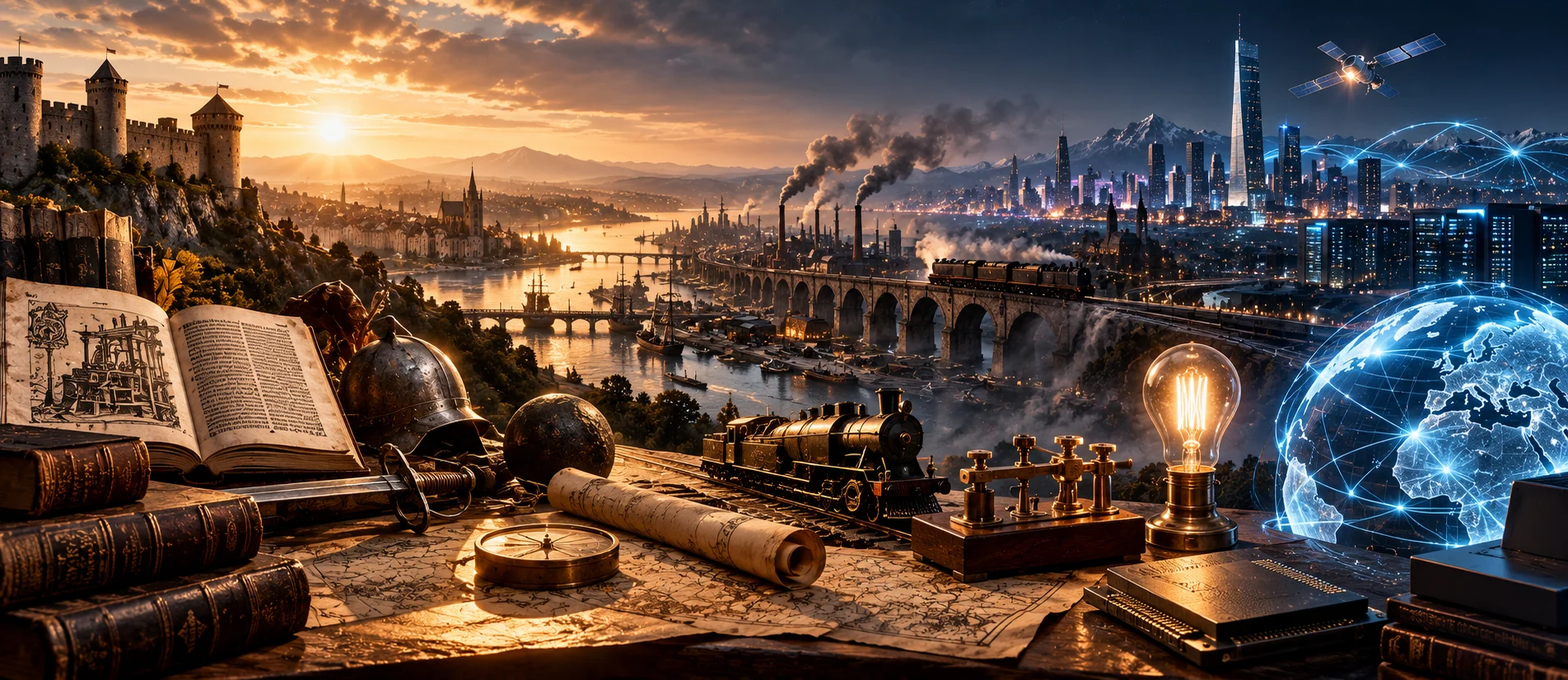
The history of technology is often told as a history of great inventions: the printing press, gunpowder, the steam engine, railways, the telegraph, electricity, computers, the internet, semiconductors and now artificial intelligence. Told that way, progress can look like a linear succession of increasingly powerful tools, each technical breakthrough replacing the one before it.
History also supports a second story. New technologies change not only what people can do, but how information can be distributed, resources mobilised, decisions implemented and large organisations coordinated. In doing so, technological change repeatedly reaches into the structures on which economic and political power depend.
It would be too simple, however, to turn that observation into technological determinism. An invention does not automatically make its owner rich, dominant or politically superior, and the society in which a technology first appears is not guaranteed to become its greatest beneficiary. What matters is whether an organisation, company or state can translate a new capability into infrastructure, finance, administration, production and institutional routines.
The history of technological power is therefore less a history of individual machines than a history of the systems that form around them.
Power is often a coordination problem
The larger a political or economic organisation becomes, the more strongly it encounters a basic problem: people, information and resources have to be coordinated across distance.
A ruler may claim an enormous territory on a map, but effective control depends on how quickly information arrives, orders travel, taxes are collected, officials are monitored, supplies are moved and soldiers can be deployed. Companies, armies and trading networks face versions of the same problem. Size alone does not create control; it first creates additional coordination costs.
A substantial part of technological development can therefore be read as a history of falling information, transport and production costs. A message that takes weeks to arrive constrains government differently from one that arrives within minutes. An army supplied by wagons and horses has a different reach from one supported by a railway network.
Technologies often do not determine directly who holds power. They change the conditions under which power can be exercised, and organisations that translate those new conditions into functioning structures more quickly can gain a substantial advantage.
1. The printing press changed control over information
Before mechanised printing in fifteenth-century Europe, reproducing substantial texts was slow, laborious and expensive. The printing press allowed written material to be produced far more quickly and in much larger quantities.[1]
What first appears to be a production innovation therefore had deep consequences for the information order. When texts become cheaper to reproduce, their potential audience grows, but so does the number of actors able to distribute ideas across greater distances.
The Reformation is one of the best-known examples. Martin Luther did not invent religious criticism or conflict with ecclesiastical authority. What changed was the speed and scale at which pamphlets, translations and religious texts could circulate compared with handwritten reproduction.[1]
A pattern appeared that would recur in later media revolutions. New communication technologies initially lower the cost of entry for actors who previously had limited reach. Established institutions lose some control over distribution while new groups can suddenly address much larger publics.
That does not guarantee permanent decentralisation. The same printing technology could subsequently be used, regulated or controlled by states, churches and other institutions. Printing did not eliminate power over information; it changed the system within which different actors competed for it.
2. Gunpowder changed not only weapons, but organisations
Gunpowder makes the connection between technology and organisation especially visible. Its military use transformed weapons, fortifications, battlefields and fleets over centuries, but its historical significance lay in more than increased destructive power.
Cannon and firearms were embedded in demanding material systems. They required raw materials, specialised craftspeople, production sites, ammunition, transport, training and sustained supply. Historians such as John Landers therefore describe gunpowder weapons not simply as new military hardware, but as developments that reached into the fiscal and economic foundations of state organisation.[2]
A local ruler might sustain a small armed retinue. A large artillery force or a standing army equipped with firearms required much more capital, logistics and administration. Building such military systems demanded more reliable revenue, larger production capacity and institutions capable of mobilising resources over time.
That could create a feedback loop: stronger political organisations were better able to finance expensive military technology, while the same technology could increase the value of large, resource-rich organisations.
Historians have long debated how strongly the so-called Military Revolution contributed to the emergence of modern states. The simple claim that gunpowder created the modern state would be too deterministic. Comparative research on Europe, China, the Ottoman Empire and other regions instead shows that the same basic technology could be adopted, financed and integrated in very different ways.[3][11]
Those differences matter because they show that possession of a technology is only part of the story. Institutional capacity to work with it over time is just as important.
3. Railways changed the geography of power
Well into the nineteenth century, movement remained one of the fundamental bottlenecks of political and economic organisation. People marched or rode, goods travelled by wagon or ship, and even the capabilities of a large state remained closely tied to the speed of physical transport.
Railways changed that equation. Large volumes of people, raw materials, food, mail and military supplies could be moved over land more quickly and predictably. Geography did not shrink, but its practical significance did.
Territories that already belonged to a state formally could now be integrated more tightly with political and economic centres. Administration, commerce and military logistics could all use the same infrastructure, which meant that railway lines were never merely transport projects.
In the United States, the federal government granted extensive land between 1850 and 1872 to support railway construction. The transcontinental system was explicitly linked to telegraph infrastructure and intended for governmental, postal and military use as well.[4]
In colonial settings, the same relationship could be even more visible. Railways opened markets and resource regions, while also making it easier to move officials and troops and bind distant territories more closely to political centres.
Technical infrastructure thus became economic and political infrastructure at the same time.
4. The telegraph changed the speed of the state
Where railways accelerated people and goods, the electric telegraph changed the speed of information.
In 1843, the US Congress granted Samuel Morse $30,000 for an experimental telegraph line between Washington and Baltimore; the famous first message was transmitted over that connection the following year.[5]
Its historical importance lay in the fact that information could now travel much faster than people and material goods. Before the telegraph, a political or military decision still had to be carried physically by messenger, horse, ship or later rail. Telegraphy partially detached information from that speed limit.
The American Civil War demonstrated early what this could mean for military command. A dedicated telegraph service operated within the US War Department, and Abraham Lincoln regularly used the telegraph infrastructure to communicate with military authorities.[6]
Its effects were not confined to warfare. Research on the adoption of the telegraph in late imperial China suggests that connected regions reported natural disasters to the central government more frequently and that improved information flows could influence state relief responses.[7]
The broader principle is straightforward: a state or organisation can respond only to events it learns about in time. Communication technologies therefore change not merely the speed of messages, but the possible speed of decision and response.
5. Infrastructure is itself a form of power
Railways and telegraphs point to a deeper pattern. The strategic value of a technology often lies not in a single device, but in the network created by many devices.
One railway line may connect two places; a dense rail network can reshape the economic structure of an entire region. One telegraph line has limited reach, while a national or international communications network creates a very different information order.
The same pattern continues with electricity grids, telephone networks, motorways, pipelines, mobile networks, fibre-optic cables, cloud infrastructure and data centres. The more economies and societies depend on such networks, the more important their nodes, standards and access points become.
Control over critical infrastructure does not mean controlling every activity that takes place on it. It can, however, influence the conditions under which energy, goods, information or capital flow.
Technological power is therefore often infrastructure power as well.
6. The Industrial Revolution made production capacity a source of power
Industrialisation brought another factor to the foreground alongside information and transport: the ability to scale production.
Pre-industrial societies could certainly produce technically sophisticated goods. What changed was the scale. Machine power, standardised components, factories, steelmaking, chemical industry, electricity, modern logistics and later mass production created industrial systems capable of producing enormous volumes of comparable goods.
That capacity shaped not only prosperity and consumption, but also the power base of states. A modern army needs far more than weapons; it depends on steel, chemicals, vehicles, spare parts, energy, communications, food, transport capacity and a financial base capable of sustaining all of them over time.
Economic and military capability therefore became more tightly intertwined. A state could sustain only those instruments of power that its economic base could produce, finance, supply and replace.
Industrialisation thus turned production capacity itself into a strategic resource.
7. The decisive technology is often not the spectacular one
Historical narratives understandably focus on visible inventions: the cannon, the locomotive, the computer. In functioning technical systems, however, those visible components are usually only the tip of a much larger structure.
A railway needs more than locomotives; it requires track standards, timetables, stations, signalling, maintenance, finance and administration. An industrial factory depends on machinery, supply chains, quality control, accounting, training, management, energy and logistics working together.
Artificial intelligence follows the same pattern. The model is the most visible element, but its operation depends on semiconductors, data centres, electricity, cloud systems, networks, data, software, security architecture, skilled labour and substantial capital investment.
The more complex a technology becomes, the more competition shifts from the invention itself to the system around it.
That also helps explain why technological superiority does not necessarily emerge where an idea first appears. What matters is whether an organisation possesses enough complementary capabilities to turn a technical possibility into a durable operating system.
8. The internet distributed power — and concentrated it at the same time
The internet initially repeated part of the printing-press pattern. The cost of distributing information collapsed, and an individual with relatively little capital could suddenly reach a global audience. Companies no longer needed their own printing presses or broadcast networks to become internationally visible.
The network therefore appeared, at first, mainly as a decentralising force. New media, new companies and new communities could emerge without passing through the traditional institutional gateways.
As the internet grew, however, a second movement developed. Certain infrastructure and platform layers became increasingly important: search engines, app stores, social networks, cloud providers, payment systems and data centres became central intermediaries of digital activity.
There is no contradiction in that. The same technology can distribute power at one layer and concentrate it at another. The internet reduced the cost of publishing while new bottlenecks formed around attention, distribution and technical infrastructure.
Technological change therefore rarely produces simply more or less centralisation. More often, it shifts the level at which centralisation occurs.
9. Semiconductors make the modern structure especially visible
Few products make the modern relationship between technology, infrastructure and strategic dependence as visible as the semiconductor.
A modern chip is physically small, while the industrial system required to produce it is extraordinarily complex. Chip design, architecture, lithography, specialty chemicals, wafer fabrication, packaging, precision manufacturing equipment, skilled labour, energy and global supply chains all have to align before a finished component emerges.
That complexity creates bottlenecks. Not every part of the value chain can be replaced quickly, and specialised capabilities can remain concentrated in a small number of companies or locations for decades.
This helps explain why governments increasingly treat semiconductors as strategic infrastructure. The European Commission's June 2026 proposal for a Chips Act 2.0 explicitly seeks to reduce strategic dependencies and strengthen capacity in advanced semiconductor technologies, while acknowledging continued European dependence in areas including advanced manufacturing and chip design.[8]
The United States likewise links semiconductors explicitly to economic and national security. In a January 2026 Section 232 proclamation, the US administration treated semiconductors and certain manufacturing equipment as important to national economic, industrial and military capability and used that assessment to justify measures aimed at reducing foreign dependence. That is the security assessment of the administration of the time, not a neutral judgement on the merits of any specific trade policy.[9]
The historical pattern is familiar. Coal, steel, oil and railway infrastructure once carried particular strategic weight; in a digital economy, computing capacity and semiconductor capability increasingly occupy a comparable position.
10. Artificial intelligence shifts the bottleneck again
Artificial intelligence extends this development because software can increasingly perform activities that once required human interpretation. Modern systems can process language, analyse images, operate software, evaluate data and break tasks into multiple steps.
That does not mean AI automatically creates political or economic power. It can, however, change the performance of organisations that use it to analyse information faster, automate workflows or coordinate complex processes with less effort.
At the same time, AI is anything but immaterial. Every capable system rests on data centres, high-performance chips, power grids, cloud infrastructure and communications networks. As demand for computing grows, the physical systems supporting digital intelligence become strategically more important as well.
The European Commission accordingly connects semiconductors, secure cloud and data infrastructure, and artificial intelligence with questions of European competitiveness, resilience and technological sovereignty in its current digital policy agenda.[10]
AI therefore looks technologically new while the underlying logic remains familiar: a new capability becomes strategically important, and almost immediately the question shifts to the infrastructure that makes that capability possible.
11. Inventors are not automatically the winners
History therefore provides a useful defence against simplistic predictions about technological power. A society can develop a technology without becoming its greatest long-term political or economic beneficiary.
China, for example, had extensive experience with gunpowder long before Europe. That fact does not lead in a straight line to any particular later balance of power. Recent research instead emphasises the complexity of exchanges among China, Europe, the Ottoman Empire and other regions, with innovation moving in more than one direction.[11]
Between invention and durable impact lie many additional questions: whether the technology can be produced reliably and at scale, whether the necessary infrastructure exists, whether sufficient capital and skilled labour are available, whether existing institutions can adapt their processes, and whether standards and supply chains emerge that support continued improvement over time.
Those are often the points at which technological pioneers and later winners begin to diverge.
The real unit of competition is therefore often not the machine itself, but the institutional, economic and technical system that supports it.
12. New technologies create capabilities — and new dependencies
Technological development is often imagined as a process of growing independence. A new machine replaces human labour, a new mode of transport overcomes distance, or a digital system reduces cost. Yet every new capability depends on new prerequisites.
A country building railways becomes dependent on rails, machinery, spare parts and energy supply. An electrified economy needs power stations, grids and transformers. A digital economy depends on semiconductors, communications networks, software and data centres; an AI-intensive economy adds very large requirements for computing capacity and energy.
Technological development therefore rarely eliminates dependence altogether. More often, it replaces older dependencies with new ones that may be more complex and less visible.
That helps explain why supply chains and technical standards have themselves become strategic questions. What matters is no longer only which technology a country or company can use, but which components, suppliers, infrastructures and institutional frameworks that technology depends on.
The recurring pattern
Viewed across several centuries, technological development does not reveal a simple law, but it does show a recurring structure.
New technologies alter the speed and reach of information. They change how many people, resources and processes can be coordinated, the scale and cost of production, and ultimately the distance over which goods, information or military force can be used effectively.
When one of those variables changes sharply, existing economic and political structures come under pressure to adapt. Some organisations exploit the new possibility early; others respond late or integrate it only partially.
Technology never determines the outcome by itself. Institutions shape how quickly rules and processes can change, capital affects the scale of investment, infrastructure determines how reliably a capability can be provided, and people ultimately decide how it should be used.
The history of technological power is therefore less a sequence of brilliant inventions than a history of organisations that were able to translate new possibilities into functioning systems faster, more reliably and at greater scale than others.
Technology does not change the nature of power — it changes its tools
From the printing press and gunpowder to railways, semiconductors and artificial intelligence, the technologies themselves change fundamentally. The underlying pattern remains surprisingly stable.
Organisations gain an advantage when they can receive and distribute information faster, mobilise resources more efficiently, coordinate more complex structures or integrate new technologies more successfully into industrial and institutional systems.
None of those advantages is permanent. Once a technology spreads, others begin to catch up. Existing bottlenecks lose importance while new ones emerge; infrastructure that once seemed secondary can become strategic, and solving one dependency often reveals the next.
Technology therefore does not decide who remains powerful indefinitely. It repeatedly changes the conditions under which economic, institutional or political power can be exercised.
That is where its historical significance lies.
Sources
- World History Encyclopedia — The Printing Press & the Protestant Reformation
- Oxford Academic — The Military Revolution and the State
- Ohio State University — Saltpeter: The Mother of Gunpowder
- Library of Congress — Land Grants and the Railroad Network
- Library of Congress — Invention of the Telegraph
- Library of Congress — David Homer Bates and the Civil War Telegraph
- Centre for Quantitative History, HKU — Telegraph, Media, and State Information Capacity in Late Imperial China
- European Commission — Proposal for the Chips Act 2.0
- The White House — Adjusting Imports of Semiconductors, Semiconductor Manufacturing Equipment, and Their Derivative Products into the United States
- European Commission — 2026 State of the Digital Decade package
- Oxford Academic — Gunpowder Technology in Global Perspective