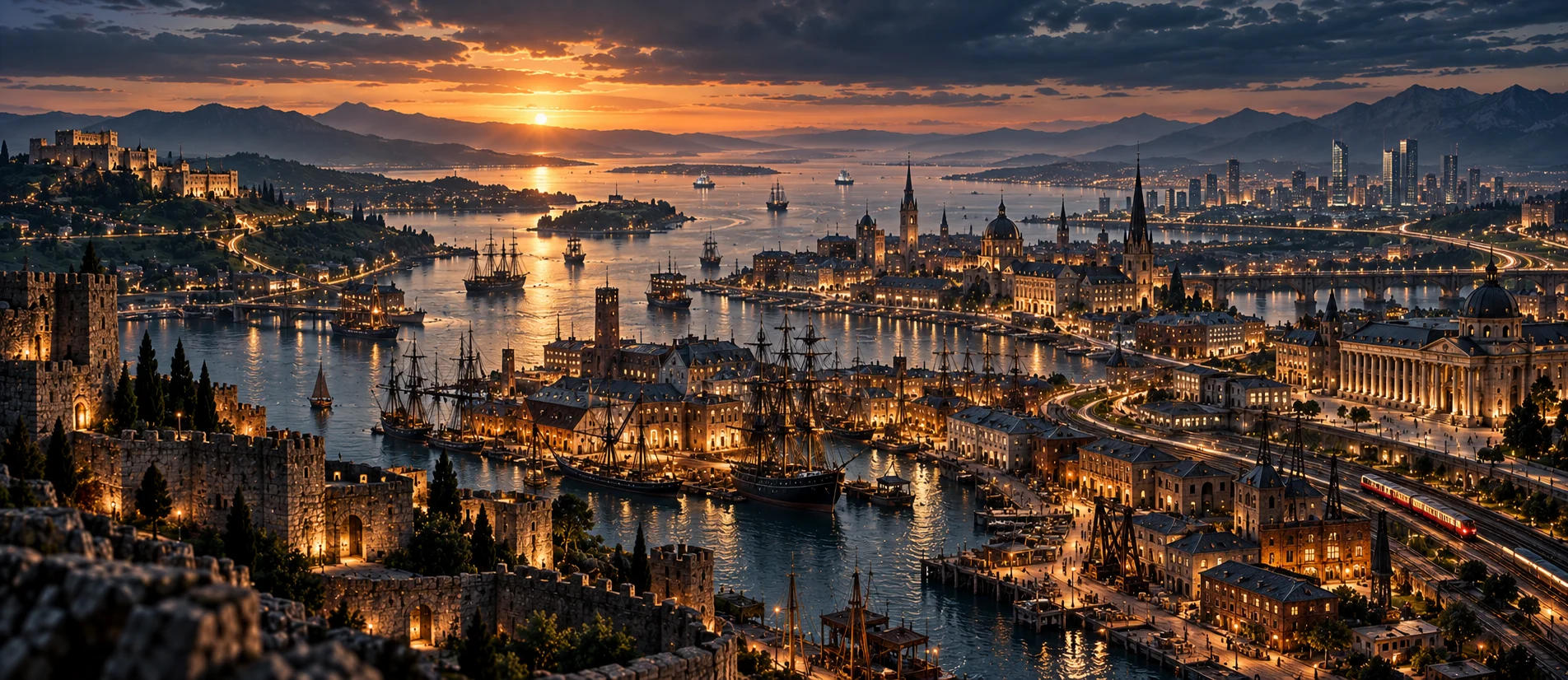
On historical maps, trade routes often look like lines connecting centres whose importance is already given. Goods leave one major city, travel by land or sea and reach another, while ports, capitals and financial centres appear as fixed points and trade merely provides the connection.
Historically, causality often ran in both directions. Political centres created security, infrastructure and legal orders that made trade easier, while successful routes allowed cities to expand, attracted capital and skilled labour and gradually shifted economic power.
Where large pools of capital accumulated, new possibilities emerged for financing commerce, fleets, infrastructure and states. Those changes could in turn reorder political power and weaken centres that had previously been dominant.
A trade route therefore does not simply link two places that are already important. Given enough time, it can help determine which places become important at all.
The history of economic centres is consequently difficult to understand if trade, capital and political power are treated separately. They form a feedback system in which each can reshape the others.
Trade routes are economic structures, not lines on a map
Geography first sets physical constraints on trade. Mountains, deserts, rivers, coastlines and distance affect which goods can be transported at tolerable cost. Historically, the gap between land and water transport was especially large, which gave rivers, coasts and navigable seas substantial influence over the location of economic centres.
Research on historical Chinese markets illustrates how strongly transport geography could shape spatial integration. Wolfgang Keller and Carol Shiue reconstruct trading patterns through regional rice prices and show that the much lower cost of shipping affected both the distance over which trade was feasible and the direction in which networks expanded.[10]
This already creates a feedback loop. A favourable route attracts commerce; growing commerce justifies investment in ports, storage, roads and administration, which can make the same route more attractive still.
A geographical advantage can therefore become an institutional and economic advantage over time.
1. Trade concentrates knowledge and relationships as well as goods
Long-distance commerce requires much more than transport capacity. Merchants need information about prices in distant markets, must judge creditworthiness and insurance risk, find reliable partners and enforce agreements where public authority may be limited.
Trading centres therefore accumulated social networks as well as harbours and marketplaces. The more merchants used a location, the more valuable its information about prices, ships, borrowers, political risks and foreign demand became. Brokers, insurers, notaries, bankers and freight specialists then emerged around those transactions and could reduce costs further.
The Hanseatic League illustrates how persistent such networks can be. A 2025 study in the Journal of International Economics follows trade for 190 years after the Hanseatic system had declined and finds no general permanent trade premium simply from former membership. The composition of commerce nevertheless remained shaped by the network because Hanseatic captains continued to serve old connections disproportionately for generations.[7]
Economic geography therefore consists of more than roads, harbours and distance. Part of its infrastructure exists in relationships between people, and those relationships can outlast the political organisation that originally helped create them.
2. Venice shows how commerce can reshape political institutions
Few European cities illustrate the relationship between trade routes, capital and political power as clearly as medieval Venice. Its position between the Mediterranean, the Adriatic and European inland markets made it a major node of long-distance commerce.
As trade expanded, the change was not confined to the wealth of individual merchants. A group of increasingly powerful commercial families emerged and their interests began to shape the republic's political institutions.
Diego Puga and Daniel Trefler show that expanding long-distance trade initially enriched a relatively broad merchant group. Their new economic strength helped them constrain the Doge and support institutions that increased participation by the commercial elite. Contractual innovations such as the colleganza also mobilised capital for risky long-distance voyages.[1]
Trade, finance and institutions therefore reinforced one another: better financing enabled more commerce, successful commerce increased wealth and political influence, and institutional change improved the conditions for further expansion.
The process did not remain open indefinitely. After 1297, exceptionally wealthy families increasingly restricted political participation and access to the most lucrative forms of long-distance trade. Puga and Trefler describe this as oligarchisation, in which an elite created by commercial success translated economic position into barriers against future competitors.[1]
Venice therefore illustrates both directions of the relationship. Trade can support political opening when new economic groups acquire influence, while successful commercial elites can later use the same institutions to restrict entry.
3. Capital follows trade — and trade follows capital
Long-distance trade requires capital because months or years may separate investment from return. Ships have to be equipped, cargo purchased and crews paid before goods can be sold, while storms, piracy, war, default and price movements add substantial uncertainty.
As trading networks grow, demand for financial institutions grows with them. Credit instruments, partnership structures, insurance and increasingly liquid securities markets developed around this need. Yet commerce did not merely consume capital; successful trade generated fortunes that then searched for further investment opportunities.
Amsterdam around 1600 provides a particularly clear example. Gelderblom and Jonker show how Dutch overseas expansion and transferable VOC shares helped create a broad secondary market accompanied by new credit techniques. By 1609, in their account, Amsterdam's capital market had become sufficiently strong to influence the terms of new public debt issues.[4]
The trading centre became a financial centre, and the financial centre facilitated further commerce. This feedback helps explain why major trading cities often developed financial infrastructures whose significance eventually reached far beyond the original flow of goods through their ports.
4. Economic centres can generate political weight
Capital matters politically because states require resources. War, fleets, administration and infrastructure were expensive long before modern welfare states, so governments with access to deep capital markets could sometimes mobilise larger sums and spread risks across longer periods.
The relationship was reciprocal. States protected shipping, controlled ports and supported merchants abroad, while merchants and financial markets supplied credit that could finance state power.
Amsterdam and London developed different but connected financial systems in the seventeenth and eighteenth centuries. Ann Carlos and Larry Neal describe an eighteenth-century symbiosis in which Amsterdam's more bank-oriented finance interacted with London's more market-oriented system, allowing both to achieve exceptional positions in European finance while supporting further commercial expansion.[5]
The geographical concentration of capital did not redraw political borders by itself, but it changed the resources available to governments and private actors. Financial centres consequently became components of state power.
5. New trade routes can shift the economic centre of a continent
European use of new sea routes around Africa and across the Atlantic is often described primarily as a geographical expansion of trade. Economically, it also changed the relative advantages of locations within Europe.
Mediterranean centres such as Venice had benefited for centuries from their position in commercial networks linking Europe with the eastern Mediterranean. When Portuguese voyages established a direct route around the Cape of Good Hope to Asia and Atlantic commerce with the Americas expanded, the opportunity set of Europe's coastal regions changed profoundly.
O'Rourke and Williamson examine the Portuguese route through European spice markets and conclude that Vasco da Gama's voyages had substantial effects on prices and market integration. The Cape route was therefore more than an additional line in an unchanged network; it altered competition between existing routes.[6]
Acemoglu, Johnson and Robinson connect the growing importance of Atlantic trade after 1500 with the long-run rise of particular western European states. Their argument is not that access to the Atlantic mechanically produced growth. The strongest effects occurred where pre-existing institutions already constrained monarchical power and rising commercial groups were able to translate economic gains into institutional change.[2]
The rise of Atlantic powers therefore appears as more than a geographical story. New routes created opportunities, while political institutions affected how those opportunities were distributed and converted into lasting power.
6. Political centres do not automatically benefit from trade
The fact that trade can create wealth does not mean its gains are automatically dispersed widely or converted into productive institutions. Historical comparisons show that the same new opportunity can generate very different outcomes under different political arrangements.
A government may use additional revenue to build infrastructure and administration; a rising merchant class may demand political participation. Existing rulers or elites can also monopolise gains, restrict commercial access or use new revenue to strengthen their position against social rivals.
Robinson and Torvik make the point in general terms: the same economic shock or opportunity can have opposing developmental effects under different institutional conditions. Their examples include the divergent consequences of the Black Death in western and eastern Europe and of Atlantic trade in Britain and Spain.[12]
Trade routes therefore have no single political effect. They change the distribution of economic resources, while institutions shape who can convert those resources into political influence.
7. Political power can deliberately shape trade flows
Influence also runs in the opposite direction. States were never merely passive observers of trading networks: they built ports, protected sea lanes, negotiated commercial privileges, imposed tariffs and granted monopolies, while also trying to exclude rivals from particular routes and markets.
Trade has therefore always involved political control as well as exchange. The Hanseatic system combined commercial cooperation with privileges and collective enforcement, while early-modern chartered companies received state-backed monopoly rights and in some cases exercised military and administrative functions themselves.
European overseas expansion made this relationship particularly violent. Trade routes were frequently supported by military force, colonial rule and coercive labour systems; Atlantic commerce included the mass enslavement and forced transportation of Africans. The Trans-Atlantic Slave Trade Database now documents more than 36,000 known transatlantic slaving voyages spanning the early sixteenth to the nineteenth century.[14]
The resulting flows of goods and capital cannot therefore be described adequately as purely voluntary market processes. Historical economic centres were created through commerce and through political actors' ability to enforce the conditions under which that commerce took place.
8. The decline of a route does not immediately destroy a centre
Economic centres often display considerable inertia. A city that has accumulated capital, knowledge, institutions and specialised labour over a long period can retain importance even when the original trading conditions begin to change.
Banks can enter new lines of business, merchants can shift to different routes and existing networks can be redirected toward new markets. The Hanseatic evidence, for example, shows that commercial and social relationships could survive the decline of the formal system for very long periods.[7]
A similar logic applies to financial centres more broadly. A location with exchanges, banks, insurers, legal expertise and international relationships possesses advantages that do not disappear immediately when particular cargo flows move elsewhere.
Economic geography is therefore often path-dependent. A trade route can create a centre, but once the centre has accumulated enough institutional and financial capital it may become less completely dependent on the route that originally produced its rise.
9. New transport technologies can reorder entire hierarchies
Path dependence does not mean immobility. New transport technologies can alter the relative value of locations dramatically by changing the cost of one route against another. Sailing technology, canals, steamships, railways, container shipping and air freight have each changed which distances matter economically and which nodes are especially valuable.
Long-run commodity-market integration was therefore far from smooth. Findlay and O'Rourke show that technological improvement played a major role in nineteenth-century integration, while politics at different times reinforced or reversed the process. Wars and severe depressions repeatedly interrupted globalisation and could leave persistent effects.[9]
Transport costs are not purely exogenous to geography either. Brancaccio, Kalouptsidi and Papageorgiou show in modern ocean shipping that trade volumes, available shipping capacity and search frictions can themselves affect route costs and generate network effects.[11]
A route can therefore become attractive because a large amount of trade already uses it, while additional trade becomes attractive because the route is already dense and well served.
10. Political borders can redraw economic geography
Trading regions do not necessarily follow political borders, yet new borders can abruptly reshape trading regions. They can introduce tariffs, security risks, different legal systems or outright prohibitions and separate places that had previously been closely integrated.
In a 2026 NBER paper, Johannes Boehm and Thomas Chaney reconstruct trade from the fourth to the tenth centuries using hundreds of thousands of ancient coin finds. Their estimates suggest that economic activity was already shifting away from the Mediterranean from the fifth century and that the later border between Islamic and Christian polities further disrupted Mediterranean trade.[8]
By the end of the ninth century, their reconstruction places some of the richest regions more strongly in Atlantic Europe and the Middle East than in the formerly dominant Mediterranean core.[8]
Economic centres therefore do not emerge from fixed geography alone. Political space can fundamentally alter the value of the same physical location.
11. Trading centres attract political attention
Where large concentrations of goods and capital emerge, interests arise that can be protected, taxed or controlled. Economic centres therefore become politically significant.
A small port has a different strategic value from one carrying major revenue and supply flows. A financial centre capable of funding substantial public borrowing occupies a different political position from an ordinary regional market.
As economic concentration grows, state investment, military protection and administrative attention can grow with it. Ades and Glaeser show in their classic study of large cities that political factors have a substantial effect on urban concentration and that economic and political centralisation cannot be treated as independent processes.[13]
An economic centre can generate political weight, while political centrality can attract additional economic resources. Capital city and trading city may therefore compete, reinforce one another or occupy the same location.
12. Capital is more geographically mobile than infrastructure
Goods, factories and populations are often tied to physical locations, whereas financial capital can move much more quickly. That difference in speed matters for the rise and decline of economic centres.
When trading opportunities move, merchants and financiers can redirect activity relatively rapidly, while harbours, warehouses, canals and entire urban districts remain where they are. A centre's economic importance can therefore decline faster than its visible infrastructure.
The reverse is also possible. Capital can accelerate the development of an emerging centre when investors expect a route or region to become more important and finance infrastructure before the eventual trade volume has fully appeared.
Capital therefore does not merely react to economic geography. It can anticipate future geography and help create it.
13. Financial centres can outlive trading centres
The relationship between trade and finance can eventually produce a partial separation. A place may become a financial centre because substantial commerce takes place there, but specialisation can later create institutions capable of financing transactions that occur somewhere else entirely.
Amsterdam and London illustrate this progression. Both benefited heavily from commerce and then developed financial markets whose reach extended well beyond the cargo handled directly by their own ports.[4][5]
The function of the centre consequently changes. It no longer needs to control every physical shipment as long as contracts, credit, insurance and securities continue to pass through its institutions.
The shift from trading centre to financial centre can therefore open a new phase of economic power in which information and capital matter more than the immediate handling of goods.
14. New centres often form where several systems intersect
Historically successful trading cities were rarely valuable merely because they lay somewhere along a long route. The most important locations were often interfaces between different transport, legal or economic systems.
A harbour can connect maritime and inland trade, a river crossing can gather regional land routes, and a financial centre can connect capital from one region with commercial opportunities in another. Such interfaces are valuable because they solve coordination problems.
Specialised services, information markets and institutional innovation frequently emerge around those problems. Merchants need currency exchange, insurance across different risks, intermediaries between legal systems and financing for transactions that cross several markets.
The more complex commerce becomes, the more valuable the node that organises this complexity can become. That also helps explain why political control over strategic chokepoints has been so valuable historically: whoever controlled a major passage, port or sea lane could enable trade, charge for access, restrict rivals and gather information about flows.
Geography often acquires economic value through the system it connects.
15. The movement of centres is usually a process, not a date
Historical accounts often say that Venice was replaced by Amsterdam, Amsterdam by London, or older Mediterranean centres by Atlantic ports. Such shorthand is useful as long as it is not interpreted too literally.
Economic centres rarely disappear at the moment a rival begins to rise. Old and new centres can coexist for long periods while different functions move gradually from one to another.
A city can lose primacy in commodity trade and remain an important financial centre. A political capital can lose economic weight while retaining significance through population and state institutions, and a harbour can lose international influence while remaining indispensable regionally.
The question of which city dominated an era can therefore conceal a collection of separate functional shifts. Commerce, finance, political power and innovation do not have to be concentrated in the same place at the same time.
16. Economic power reshapes political power — and vice versa
The deeper historical logic lies in the conversion between different forms of power. Trade generates profit, profit can accumulate into capital, and capital finances firms, infrastructure and states. Large economic resources can therefore create additional political bargaining power.
Political actors can simultaneously alter property rights, grant monopolies, restrict competitors, protect trade routes or block alternatives. Political power changes the conditions under which economic fortunes can be created.
Acemoglu, Johnson and Robinson describe this interaction more generally as a dynamic relationship between economic institutions, the distribution of resources and political power. Groups that become economically stronger can acquire greater de facto influence and attempt to translate that influence into formal institutional change.[3]
The history of trade is therefore also political history, not because every merchant possesses political power, but because long-run shifts in capital can alter the wider distribution of influence.
17. Successful centres contain the seeds of their own transformation
One of the most interesting patterns appears when economic success creates actors who later change the order that made their rise possible. Venice's merchants first constrained political power and supported institutions favourable to long-distance trade before part of the same elite increasingly closed access to political and commercial opportunity.[1]
Atlantic trade strengthened commercial groups in parts of Europe that could support institutional change, while financial markets enabled states to mobilise greater resources and thereby altered state power as well.[2][5]
Every successful trading system therefore changes the actors within it. Given enough time, it generates new fortunes, interests and power relationships that can stabilise the original order or begin to reconstruct it.
Economic centres are not static winners of geographical competition. Their own success changes the conditions of their future success.
Trade routes change the world because they change relationships between places
The history of economic centres cannot be explained by geography alone or by politics alone. Geography creates possibilities, infrastructure determines how intensely they can be used, trade moves information and people as well as goods, and capital finances new commercial opportunities while potentially strengthening political power.
Political institutions in turn determine who can access those opportunities, which risks are protected and how gains are distributed. Centres emerge from this interaction.
Venice did not become important solely because of location. Amsterdam did not become a financial centre simply because Dutch merchants were unusually capable, and London's rise was inseparable from commerce, state power and capital markets. Older centres likewise did not disappear merely because a new line appeared on a map.
Each shift reflected a combination of geography, networks, capital, technology and political order whose components reinforced or weakened one another.
Trade routes should therefore not be understood merely as connections between pre-existing centres of power. Over time they change the places themselves: a harbour brings merchants together, merchants create financial institutions, capital finances states and infrastructure, political power protects or controls routes, and those routes generate new fortunes and competitors.
Historical centres move because the entire system around them remains in motion.
Sources
- Diego Puga & Daniel Trefler — International Trade and Institutional Change: Medieval Venice's Response to Globalization (NBER / QJE)
- Daron Acemoglu, Simon Johnson & James A. Robinson — The Rise of Europe: Atlantic Trade, Institutional Change, and Economic Growth (AER, 2005)
- Daron Acemoglu, Simon Johnson & James A. Robinson — Institutions as the Fundamental Cause of Long-Run Growth (NBER, 2004)
- Oscar Gelderblom & Joost Jonker — Completing a Financial Revolution: The Finance of the Dutch East India Trade and the Rise of the Amsterdam Capital Market, 1595–1612 (Journal of Economic History, 2004)
- Ann M. Carlos & Larry Neal — Amsterdam and London as financial centers in the eighteenth century (Financial History Review, 2011)
- Kevin H. O'Rourke & Jeffrey G. Williamson — Did Vasco da Gama Matter for European Markets? (NBER, 2005; Economic History Review, 2009)
- Max Marczinek, Stephan Maurer & Ferdinand Rauch — Networks in trade: Evidence from the legacy of the Hanseatic League (Journal of International Economics, 2025)
- Johannes Boehm & Thomas Chaney — Trade and the End of Antiquity (NBER, April 2026)
- Ronald Findlay & Kevin H. O'Rourke — Commodity Market Integration, 1500–2000 (NBER, 2001)
- Wolfgang Keller & Carol H. Shiue — The Origins of Spatial Interaction (NBER, 2003)
- Giulia Brancaccio, Myrto Kalouptsidi & Theodore Papageorgiou — Geography, Search Frictions and Endogenous Trade Costs (NBER, 2017; rev. 2018)
- James A. Robinson & Ragnar Torvik — Institutional Comparative Statics (NBER, 2011)
- Alberto F. Ades & Edward L. Glaeser — Trade and Circuses: Explaining Urban Giants (NBER / QJE)
- SlaveVoyages — Trans-Atlantic Slave Trade Database